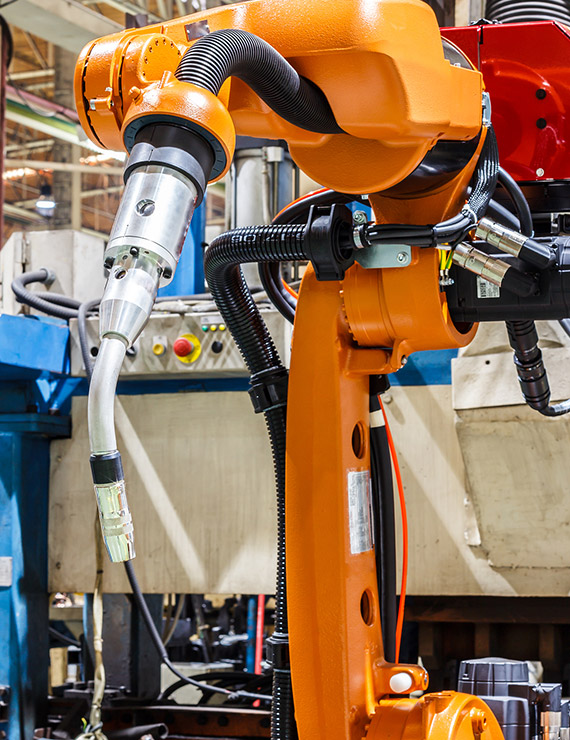

Robotic systems demand the highest level of cable performance available. Industrial robots, collaborative robots, automated guided vehicles (AGVs), and articulated arms operate through millions of precisely controlled motions, subjecting their cable assemblies to continuous torsional stress, bending, and flexing across multiple axes. Cable failure is a leading cause of robot downtime, making cable selection critical to system reliability.
Robot cables are engineered for torsional reliability. Special stranding designs allow conductor groups to shift and accommodate twisting motion without work hardening or breaking. Flexible robot cables incorporate fine copper strands, flexible insulation, and low-friction bedding layers that enable smooth motion within the robot’s cable guide tubes or internal pathways.
Signal integrity is paramount for robot applications. Encoder and feedback cables use paired conductors with individual shielding and an overall shield to reject electrical noise generated by variable frequency drives and welding equipment. For the most demanding applications, continuous-flex robot cables are tested to ten million cycles or more at tight bend radii. PUR jackets provide superior resistance to oils, coolants, and abrasion found on automated assembly floors. Collaborative robots require even lighter, more flexible cable constructions that do not impede the robot’s force-sensing capabilities. By selecting correctly engineered robotic cables, integrators and end users maximize equipment uptime, reduce maintenance frequency, and achieve higher production throughput.